Onlayn ödənişlər: təhlükəsiz əməliyyatlar və fırıldaqçılığa qarşı tədbirlər
Antifraud systems are designed to detect fraudulent activity during online payments and remote banking services. The term “antifraud” comes from the English word “fraud”, meaning deception or swindling. The description below follows the approach and examples published by Tickets.az on their antifraud and payment verification practices.
What antifraud systems do
Antifraud solutions monitor the movement of funds and try to prevent financial fraud. They analyze payment attempts and decide whether a transaction should proceed or require additional verification.
These systems do not control the internal operations of banks, and a legitimate user’s transaction can still be marked as suspicious by antifraud filters. When that happens, payment acceptance may be affected even if the payer believes the operation is valid.
Common reasons a payment is flagged
Tickets.az lists several main reasons why antifraud filters may treat a transaction as suspicious. One key reason is when an online payment is made from a country different from the country where the card was issued.
Another reason is if the card appears in an antifraud database “blacklist”. Cards that are associated with previous fraudulent activity can be blocked automatically.
Cards issued in countries with a high frequency of card-related crime are also often treated with increased scrutiny. According to the source, such countries are typically located in parts of Asia, Africa, and Latin America.
There are additional reasons a bank card may be rejected for payment. Tickets.az refers readers to a separate article that explains other possible causes for card payment rejection.
How antifraud systems respond to suspicious transactions
When a transaction triggers antifraud rules, systems may take several actions. In some cases, the card is automatically blocked right after the card details are entered.
Payment functionality can be disabled without a detailed public explanation, preventing the attempted transaction from completing. This measure is intended to stop potentially fraudulent operations promptly.
Payment systems may contact the payer by e-mail to request proof that they are the legitimate cardholder. The e-mail typically asks the payer to confirm the lawful use of the card and to send supporting documents.
In other instances, the payer may be asked to complete online verification checks proposed by the payment processor to ensure that the payer is indeed the owner of the bank card.
Document-based verification process
If card details raise concern, the payer receives a verification e-mail explaining which documents are required. The sample message in the Tickets.az source addresses the customer politely and requests confirmation of the legality of card usage.
The documents requested for successful verification include a copy of the passport first page of the card owner and a copy of the front side of the plastic payment card used. The card copy should clearly show the last four digits; other digits may be obscured for security.
The instruction allows hiding all card numbers except the final four digits. Technical specialists analyze the submitted documents and data to validate the payment and to continue ticket issuance and subsequent processing.
Practical considerations and limitations
These antifraud measures are intended to reduce financial fraud, but they can also delay legitimate transactions. Users should be prepared to submit required documents if contacted and to follow the verification steps provided by the payment system.
Because antifraud systems operate independently of bank internal policies, the exact triggers and thresholds are not always transparent to end users. The actions described by Tickets.az illustrate typical responses but do not cover every possible scenario.
Conclusion
Antifraud checks are a standard part of online payment security. They help detect suspicious patterns such as cross-border usage, blacklist hits, and cards issued in countries with higher incident rates.
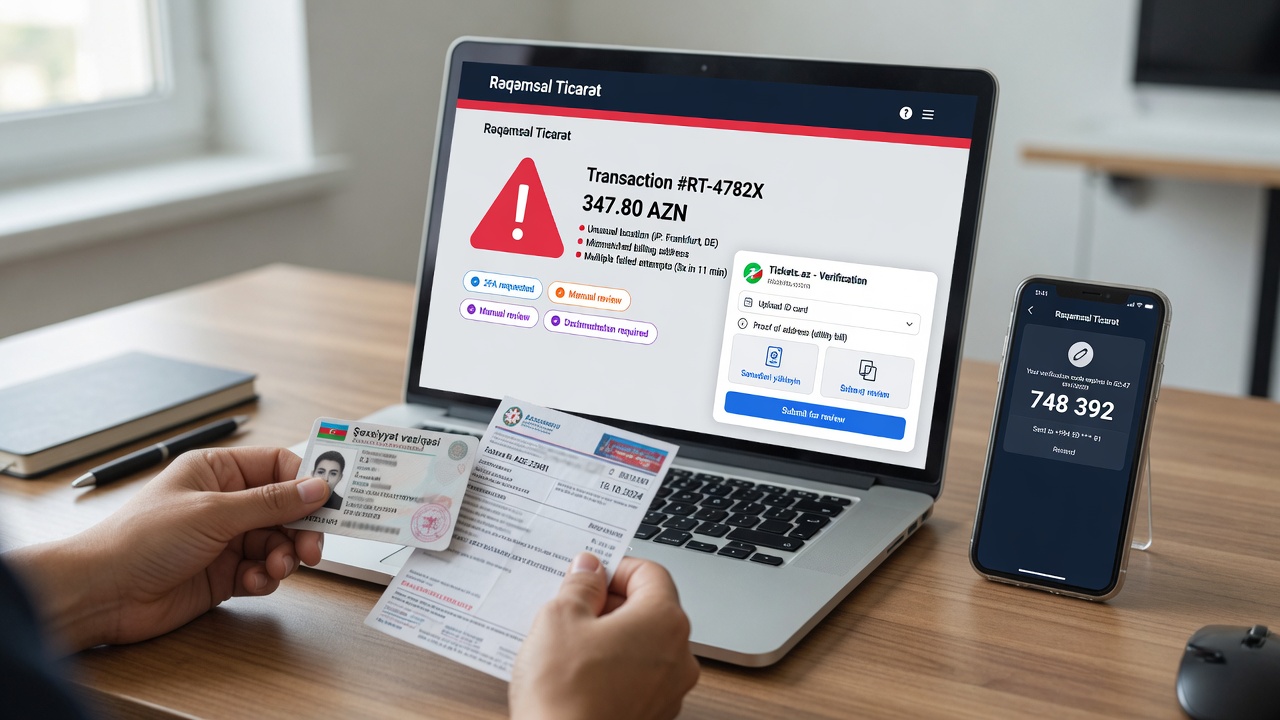
When a payment is flagged, systems may block the card, disable payment attempts, request document confirmation by e-mail, or propose online verifications. Providing the documented evidence listed by Tickets.az—passport first page and a card front copy with the last four digits visible—allows technical specialists to analyze and decide on the validity of the transaction.